
Clinical Efficacy Evaluation of Liaoning Sea Cucumber Compound Albumin Peptide Preparation for Short-term Elevation of Serum Albumin and Nutritional Improvement in Patients with Hypoalbuminemia
Serum albumin (ALB) is the most abundant protein in plasma. It maintains colloid osmotic pressure, transports numerous endogenous and exogenous substances, and regulates redox homeostasisNational C…. Clinically, hypoalbuminemia is not only caused by insufficient protein intake, but also frequently observed in patients with chronic inflammatory diseases, malignant tumors, liver cirrhosis, chronic kidney disease, severe infections, and perioperative periods of major surgery. Its pathogenesis is multifactorial, including reduced synthesis, increased catabolism, altered distribution, hemodilution, and protein loss [1,2].
Notably, albumin is a negative acute-phase protein, and its concentration is strongly regulated by inflammatory mediatorsNational C…. Academic bodies have clearly stated that serum albumin alone should not be used as the sole indicator of nutritional intervention outcomes. Instead, a comprehensive assessment combining dietary intake, body weight/fluid status, muscle mass and function, and inflammatory markers is recommended [3-5]. Nevertheless, in patients with relatively stable or gradually alleviated inflammatory burden, adequate nitrogen supply via nutritional intervention may still lead to an increase in serum albumin, especially in those complicated with gastrointestinal malabsorption or poor appetite [3,4].
Intravenous human serum albumin infusion remains the traditional treatment, yet it carries high costs, limited supply, and risks of fluid overload or transfusion-related adverse events in certain clinical scenarios. Therefore, sustainable outpatient and home-based nutritional support strategies are urgently needed as foundational therapy [6].
Oral nutritional supplements (ONS) are widely adopted for hypoalbuminemia owing to their convenience for continuous outpatient and home useASPEN. Peptide-based formulas are composed of small dipeptides and tripeptides, which can be rapidly absorbed via peptide transporters with less dependence on digestive enzymes. For patients with poor gastrointestinal tolerance or impaired absorption, peptide formulas are more likely to achieve targeted protein intake compared with whole-protein formulas [7-9].
The Liaoning sea cucumber compound albumin peptide preparation is an ONS with short oligopeptides as the main nitrogen source. Theoretically, it improves nitrogen utilization efficiency through peptide transporter-mediated rapid absorption, providing a feasible protein supplementation option for patients with poor gastrointestinal tolerance or malabsorption.
Given that hypoalbuminemia is closely associated with inflammation, intestinal barrier function and hepatic protein synthesis, emerging evidence on anti-inflammatory and antioxidant effects of marine bioactive peptides suggests potential benefits for improving internal homeostasis [7-10].
This prospective self-controlled trial was designed to observe the short-term albumin-raising effect and safety of Liaoning sea cucumber compound albumin peptide preparation in hypoalbuminemic patients, so as to provide clinical evidence for ONS implementation and patient management.
Objectives and Methods
Objective
To evaluate the short-term efficacy and safety of Liaoning sea cucumber compound albumin peptide preparation in elevating serum albumin and improving nutritional status among patients with hypoalbuminemia.
Methods
A total of 99 patients with baseline serum albumin (ALB) < 40 g/L were enrolled. On the basis of conventional treatment and dietary nutrition guidance, all subjects received the Liaoning sea cucumber compound albumin peptide preparation. Changes in serum ALB and total protein (TP) before and after intervention, clinical efficacy and safety outcomes were compared.
Results
Changes in Serum ALB and TP Levels Before and After Intervention
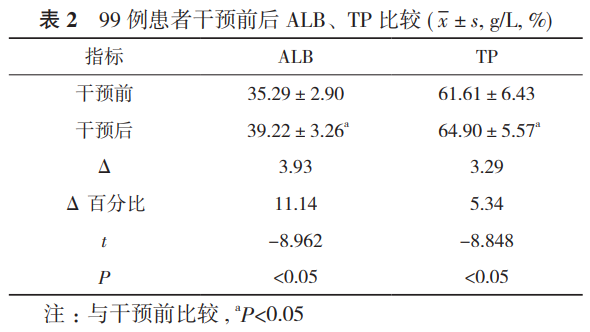
After intervention, serum ALB (39.22±3.26) g/L and TP (64.90±5.57) g/L were significantly higher than baseline values [(35.29±2.90) g/L and (61.61±6.43) g/L, respectively] (P<0.05). See Table 2.
Clinical Efficacy and Safety
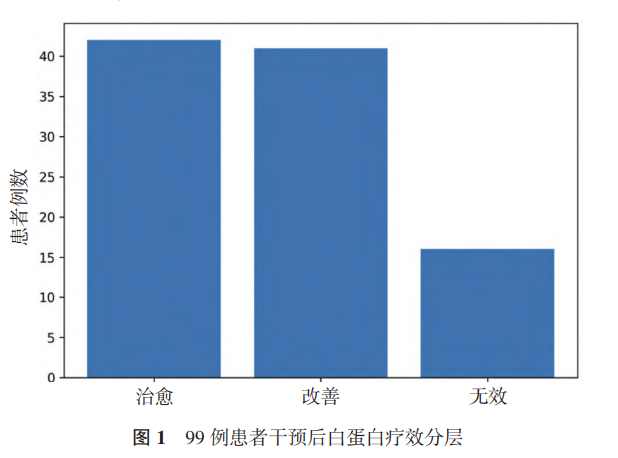
Among the 99 patients, 42 cases achieved clinical cure (42.4%), 41 cases showed improvement (41.4%), and 16 cases had no response (16.2%), with an overall effective rate of 83.8% (Figure 1). Only one patient developed mild diarrhea during the intervention, which resolved after symptomatic treatment. No serious adverse reactions were recorded.
Discussion
Hypoalbuminemia is a common complication in patients with malignant tumors, liver cirrhosis, chronic kidney disease, severe infection, and perioperative major surgery. It results from multiple factors including inadequate nutritional intake, elevated inflammatory load, impaired hepatic synthesis, excessive protein consumption, and protein loss [1,3,11].
Clinically, decreased albumin reflects both nutritional risk and inflammatory severity, and is strongly correlated with adverse clinical outcomes. Hence, albumin changes should be interpreted within the integrated framework of disease stability and nutritional supply [5].
The present study demonstrated that 10-day intervention with Liaoning sea cucumber compound albumin peptide preparation significantly increased serum ALB and TP levels……
References
[1] Li Y, Chen L, Yang X, et al. Dynamic association of serum albumin changes with inflammation, nutritional status and clinical outcomes: a secondary analysis of a large prospective observational cohort study. Eur J Med Res, 2025, 30(1):679.
[2] Zhang N, Xie L, Zhang S, et al. Inflammatory storm and metabolic disorders: unraveling heterogeneity in mortality risk for comorbid diabetes mellitus and heart failure via the C-reactive proteintriglyceride-glucose index. Front Endocrinol (Lausanne), 2025(16): 1689238.
[3] Evans DC, Corkins MR, Malone A, et al. The Use of Visceral Proteins as Nutrition Markers: An ASPEN Position Paper. Nutr Clin Pract, 2021, 36(1):22-28.
[4] Cogle SV, Hallum M, Mulherin DW. Applying the 2022 ASPEN adult nutrition support guidelines in a 2024 ICU. Nutr Clin Pract, 2024, 39(5):1055-1068.
[5] Schuetz P, Seres D, Lobo DN, et al. Management of disease-related malnutrition for patients being treated in hospital. Lancet, 2021, 398(10314):1927-1938.
[6] Zhang Y. Chinese Expert Consensus on Clinical Application and Management of Human Serum Albumin. Chinese Journal of Hospital Pharmacy, 2024, 44(7):739-751.
[7] Wang Y, Li Y, Li H, et al. Small peptide formulas versus standard polymeric formulas in critically ill patients with acute gastrointestinal injury: a systematic review and meta-analysis. Sci Rep, 2023, 13(1):20469.
[8] Bhurayanontachai R, Wacharasint P, Somboonviboon D, et al. Comparative efficacy of peptide-based versus standard polymeric enteral nutrition in ICU patients at high nutritional risk: a multicenter randomized controlled trial. Sci Rep, 2024, 14(1):14349.
[9] Sumritpradit P, Shantavasinkul PC, Ungpinitpong W, et al. Effect of high-protein peptide-based formula compared with isocaloric isonitrogenous polymeric formula in critically ill surgical patient. World J Gastrointest Surg, 2024, 16(6):1765-1774.
[10]Wu JM, Ho TW, Lai IR, et al. Parenteral glutamine supplementation improves serum albumin values in surgical cancer patients. Clin Nutr, 2021, 40(2):645-650.
[11]Jiang Y, Yang Z, Wu Q, et al. The association between albumin and C-reactive protein in older adults. Medicine (Baltimore), 2023, 102(34):e34726.
[12]Liu PJ, Guo J, Zhang Y, et al. Effects of oral nutritional supplements on the nutritional status and inflammatory markers in patients on maintenance dialysis: a systematic review and meta-analysis of randomized clinical trials. Clin Kidney J, 2023, 16(11):2271-2288.
[13]Feng J, Wang H, Luo X, et al. Identification and molecular mechanism of the anti-inflammatory effect of sea cucumber peptides: Network pharmacology, molecular docking and animal experiments. Int J Biol Macromol, 2024, 279(Pt 2):134958.
[14]Rahabi M, Salon M, Bruno-Bonnet C, et al. Bioactive fish collagen peptides weaken intestinal inflammation by orienting colonic macrophages phenotype through mannose receptor activation. Eur J Nutr, 2022, 61(4):2051-2066.
[15]Zhu Z, He L, Bai Y, et al. Yeast β-glucan modulates macrophages and improves antitumor NK-cell responses in cancer. Clin Exp Immunol, 2023, 214(1):50-60.
[16]Son J, Hwang Y, Hong EM, et al. Effects of Dietary Yeast β-1, 3/ 1, 6-D-Glucan on Immunomodulation in RAW 264.7 Cells and Methotrexate-Treated Rat Models. Int J Mol Sci, 2024, 25(20):11020.
[17]Allison SP, Lobo DN. The clinical significance of hypoalbuminaemia. Clin Nutr, 2024, 43(4):909-914.
[18]Bretschera C, Boesiger F, Kaegi-Braun N, et al. Admission serum albumin concentrations and response to nutritional therapy in hospitalised patients at malnutrition risk: Secondary analysis of a randomised clinical trial. E Clinical Medicine, 2022(45):101301.
Post time: Nov-09-2026


