
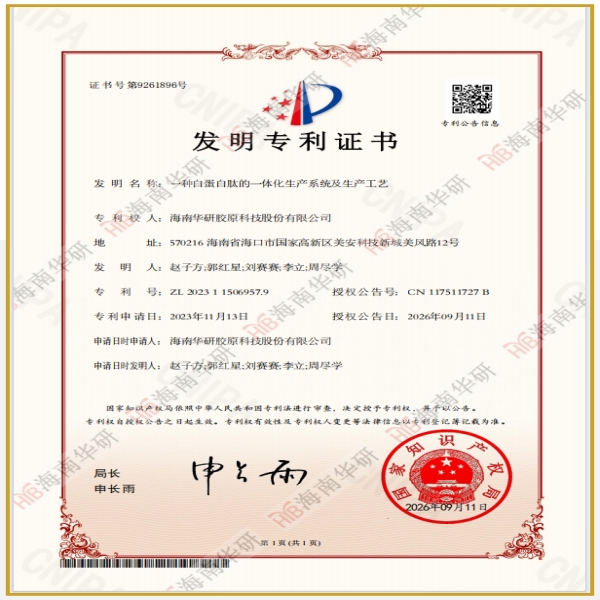
Recently, Hainan Huayan Collagen Technology Co., Ltd. has obtained authorization for a national invention patent for its independently developed “Integrated Production System and Process for Albumin Peptides” (Patent No.: ZL202311506957.9). This delivers a more systematic and stable technical solution for manufacturing albumin peptides from raw materials to finished products.
Yet for most readers, more worthy of understanding than the “patent” itself is albumin peptides. What are they? What are their nutritional characteristics? What can current research tell us? This article aims to explain the topic clearly in one read.
Opening Remarks: Why Peptides Represent the Next Frontier for Protein
To understand albumin peptides, we first need to grasp a major industry shift: our demand for protein is evolving from “consuming enough” to “consuming high-quality protein with good absorbability”.
On one hand, while adequate food supply is no longer a challenge, effective nutrient uptake and utilisation remain a bottleneck. According to the China Peptide Nutrition White Paper, China faces coexisting undernutrition and overnutrition among residents. The average daily protein intake per standard adult is approximately 60.4 grams, leaving room for improvement in high-quality protein supply. Meanwhile, population ageing continues to deepen — people aged 60 and above accounted for 18.7% of China’s total population in 2020.[1] Furthermore, the Chinese Dietary Reference Intakes (2023 Edition) raised the recommended protein intake for adults aged 65 and above from 0.98 g/(kg·day) to 1.17 g/(kg·day).[2] More people need protein, yet not everyone retains efficient protein absorption capacity.
On the other hand, the way we utilise protein is also upgrading. From natural whole foods, to protein powder, and now small-molecule peptides — protein molecules keep getting smaller. Food-derived oligopeptides generally consist of 2–9 amino acids with a molecular weight below 1000 Daltons (Da). They can be absorbed with minimal digestion or without complex breakdown, featuring fast absorption and low energy consumption. This precisely addresses the needs of groups with compromised digestive function.
Demand gaps, mature production technologies and supportive policies are driving this trend. Both the National Nutrition Plan (2017–2030) and the Healthy China Initiative (2019–2030) advocate intake of high-quality protein foods and robust development of premium protein products. Industry data also validates this growth: China’s peptide market expanded from CNY 57.34 billion in 2016 to CNY 102.32 billion in 2020, representing a compound annual growth rate of roughly 15.6%.[3]
Against this backdrop, albumin peptides sourced from egg white serve as a highly representative ingredient. We break down this raw material in detail below.
I. Starting from an Egg White: What Are Albumin Peptides?
Egg white is widely recognised in nature as a premium protein source. Its main components are albumin proteins such as ovalbumin, featuring a balanced amino acid profile. For decades in nutrition science, egg protein has been used as the reference protein for evaluating other protein sources.
Albumin peptides are small-molecule polypeptides produced using egg white powder as raw material. Bioenzymatic hydrolysis cuts large protein molecules into shorter peptide fragments. Hainan Huayan’s albumin peptides have molecular weights predominantly below 1000 Da.
Why break proteins down into smaller fragments? After ingestion, proteins must first be digested into small peptides and amino acids before absorption and utilisation. This digestive step often becomes a bottleneck for people with weak digestion. Pre-hydrolysing macromolecular proteins into small peptides means part of the digestive workload is completed in advance, easing the nutritional burden on the human body.
II. Two Core Nutritional Indicators: Amino Acid Profile & Biological Value
To judge protein quality, nutritionists mainly evaluate two dimensions: comprehensiveness of amino acid composition and the body’s actual capacity to absorb and utilise the protein.
1. Amino Acid Profile: Close to the Human “Gold Standard”
Egg protein is known as reference protein in nutrition science, achieving a full score on the Amino Acid Score (AAS)[4]. It contains all essential amino acids in proportions closely matching human physiological requirements.
Specifically, albumin peptides and their parent protein feature the following attributes: ✅ Complete amino acid spectrum | Contains all 8 essential amino acids required by humans plus multiple peptide substances. ✅ Rich in sulphur-containing amino acids | Methionine and cysteine levels stand out among common proteins; branched-chain amino acid content is comparable with dairy-derived protein. ✅ High glutamic acid / glutamine content | Accounts for approximately 18%. These amino acids support gut health and overall metabolism.
Available data shows the amino acid profile of albumin peptides resembles that of human serum albumin. Important clarification: this similarity refers to nutritional resemblance — matching amino acid composition patterns for easy bodily utilisation. It cannot replace medical albumin preparations.
2. Biological Value (BV): Protein That the Body Can Truly Utilise
Biological Value (BV) is a classic metric measuring how efficiently protein is used by the body. Reports indicate egg white protein reaches a BV of 94[5], ranking among high-value proteins. Its in-vivo digestibility normally exceeds 90%.
3. Small Molecules: Delivering True High Absorbability
Peptide fragments under 1000 Da can be directly absorbed by the small intestine without elaborate digestion, shortening the absorption pathway and lowering gastrointestinal strain. Hainan Huayan albumin peptides adopt process and quality controls built around “small molecular weight and easy absorption”, which distinguishes them from ordinary protein powder.
III. Research Progress on Albumin Peptides: What We May State at This Stage
Instead of vague descriptive claims, we organise publicly verifiable research findings by research direction. Please note this critical premise first:
Understanding Levels of Scientific Evidence
The hierarchy of scientific evidence generally progresses sequentially: in vitro/cell experiments → animal studies → human clinical trials. Lower-tier studies are exploratory basic research; higher-tier evidence better reflects effects in humans, yet such high-level data remains limited. Most research cited below sits at cellular and animal experimental stages. These represent objective discoveries from scientific exploration, not confirmed human efficacy outcomes, and definitely not therapeutic effects for diseases.
1. Immunity-Related Research
Literature reviews demonstrate that small peptides obtained from enzymatic hydrolysis of egg white protein (ovalbumin) show positive effects on immune indicators including macrophage phagocytosis capacity, NK cell activity and hemolysin levels in animal models.
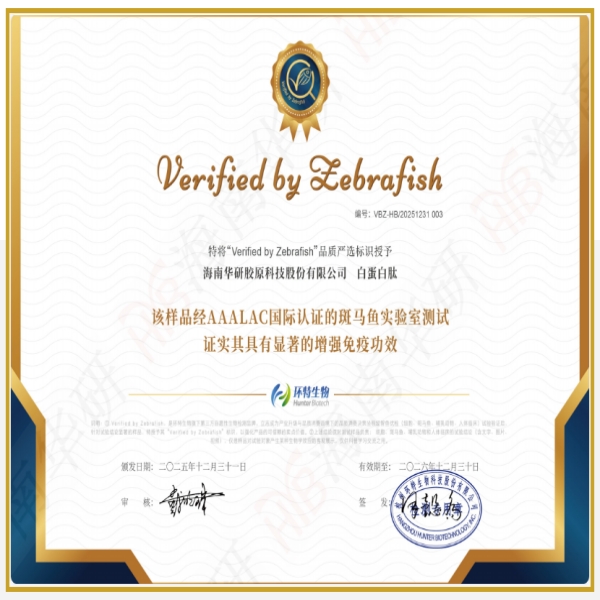
Hainan Huayan commissioned third-party testing by Pharmaron Biotech (AAALAC-accredited international laboratory animal institution) to assess the immune-enhancing activity of albumin peptides. In zebrafish models, the sample induced biological immune effects reflected by increased macrophage fluorescence intensity, with statistically significant differences versus the control group (p<0.001)[6].
Post time: Sep-20-2026


