
Good News | Achievements from University-Enterprise Joint Research: Hainan Huayan Obtains New Invention Patent
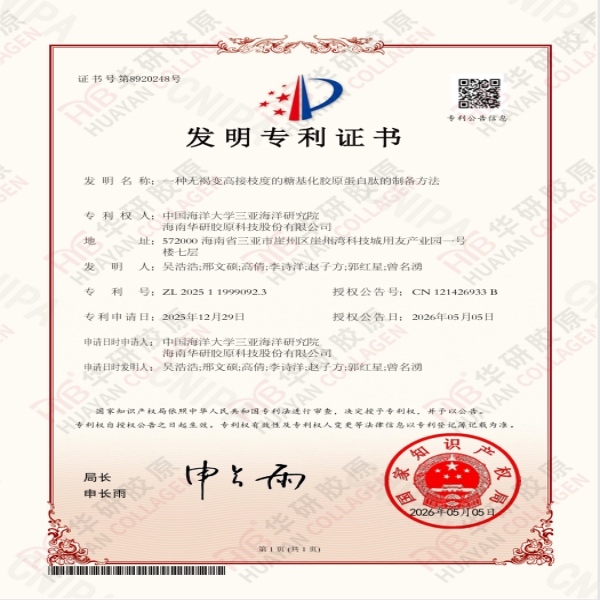
Recently, A preparation method for non-browning, high-grafting-degree glycosylated collagen peptides — jointly developed by Hainan Huayan Collagen Technology Co., Ltd. and the Sanya Oceanographic Institute of Ocean University of China — has officially been granted an invention patent by the National Intellectual Property Administration of China. This marks another major breakthrough for Hainan Huayan in core technology research on collagen peptides, and bears witness to new fruitful progress in the industry-university-research collaboration between the two parties in the field of bioactive peptides.
Terms such as “non-browning” and “high grafting degree” may sound technical. What problems does this technology actually solve? What tangible benefits can it bring to consumers and business clients? This article explains this major technological milestone in plain language.
Why Glycosylation? What Makes It So Challenging?
Collagen peptides feature low molecular weight and easy absorption. They are high-value-added raw materials widely used in functional foods, cosmetics, pharmaceuticals and other sectors. With consumption upgrading, the market demand for collagen peptides is no longer limited to basic availability; buyers expect better absorption, superior processability and higher stability. To further improve oral bioavailability and expand application scenarios, researchers have turned to glycosylation modification. Simply put, glycosylation uses covalent bonding (via the Maillard reaction) between reducing sugars and amino groups on peptide molecules to attach sugar chains to peptide molecules. This optimizes molecular structure, solubility and functional properties.
Promising as this approach is, it has long been blocked by two bottlenecks:
- Low grafting degree: Only a small amount of sugar chains are attached with weak binding. The modification effect is greatly compromised.
- Severe browning: Substances such as melanoidins generated during the reaction darken the product, turning it yellow or brown, and may introduce burnt or bitter off-flavors.
To draw an analogy, this process resembles caramelization or bread baking: sugar reacts with protein under high heat, causing color change and flavor shift. While desirable in food such as baked goods, discoloration is a critical drawback for collagen peptides, which are valued for purity and clarity. Achieving both high grafting efficiency and zero discoloration has long restricted the industrial application of this technology.
The Combined “Hydrothermal Treatment + Ball Milling” Strategy: High Grafting Without Browning
Traditional prolonged high-temperature processes rarely achieve both high grafting degree and browning inhibition. This invention adopts an innovative green and efficient preparation process combining precisely controlled hydrothermal reaction with mechanochemical effects from ball milling:
- Add reducing sugars into a high-concentration collagen peptide solution at a peptide‑to‑sugar molar ratio of 1:0.5~1.5 and stir until fully dissolved.
- Adjust the pH of the solution to 6.0–8.0 and carry out the reaction at 70℃–90℃ for 15–60 minutes.
- After drying, treat the dried product in a ball mill at a rotational speed of 200–600 r/min for 30–240 minutes.
Through precise regulation of reaction temperature, duration, pH, sugar‑peptide ratio and ball milling parameters, this process enables green, efficient modification of collagen peptides with a high grafting degree. The final glycosylated collagen peptide features high grafting degree and no browning. Tests verify that this new process fundamentally addresses the two core pain points of conventional Maillard reactions — low grafting rate and severe browning — and significantly raises the oral bioavailability of the resulting peptides.
What Are the Advantages of “Non-Browning”?
Browning is an easily overlooked factor in glycosylation yet strongly impacts user experience. The benefits of non-browning performance are straightforward:
- Visually pure appearance. Premium collagen peptide powder is supposed to be white and form clear solutions. Products from conventional processes turn yellow or brown after browning. Consumers often suspect spoilage when their dissolved peptide drink turns yellow. For brand owners, poor appearance undermines product credibility. Non-browning peptides deliver whiter powder and clearer solutions for a cleaner visual profile.
- Clean, neutral taste. Browning is usually accompanied by burnt, bitter or miscellaneous flavors that mask the original formula taste. Non-browning peptides maintain a pure flavor profile without off-notes. They work well for unflavored formulations and give formulators greater flexibility for flavor development.
- Superior storage stability. The Maillard reaction continues slowly at ambient temperature, causing progressive yellowing and inconsistent color across batches. This non-browning process suppresses this tendency at the source, ensuring stable color and consistent batches throughout the shelf life. For manufacturers, this means fewer quality control headaches and lower complaint risks.
- Eligibility for high-end sensitive applications. Transparent beverages, oral liquids, serums and facial masks are highly sensitive to color. Even slightly yellow raw materials can ruin the finished product. Non-browning glycosylated collagen peptides avoid color contamination and are ideal for premium, clear finished goods.
What Does “High Grafting Degree” Mean?
If non-browning solves sensory issues (appearance and taste), high grafting degree improves functional performance and cost-effectiveness:
- Higher utilization efficiency after intake. Sugar chain grafting greatly enhances the bioavailability of peptides. In practical terms, a single serving delivers more absorbable active ingredients. Consumers get better value; brands gain stronger functional claims with the same addition dosage.
- Excellent cold-water dispersibility. Attached sugar chains improve peptide solubility. The powder dissolves quickly without caking or wall adhesion in cold or warm water. For manufacturers, blending and filling run more smoothly with fewer production defects.
- Enhanced resistance to harsh conditions. The modified molecular structure is more thermostable and acid-resistant. It also resists premature degradation during digestion so more active peptide reaches target sites. In short, a greater proportion of the consumed peptide remains bioactive.
- Additional antioxidant activity. Glycosylated products naturally possess favorable antioxidant properties as an added benefit. Combined with the strengths of whiteness, purity, stability and superior absorption, these peptides qualify for demanding high-end sectors including premium functional foods, oral beauty supplements and special dietary foods, helping brands lift raw material value.
University-Enterprise Collaboration: Fruit of Deep Industry-University-Research Integration
This patent is jointly developed by Hainan Huayan and the Sanya Oceanographic Institute of Ocean University of China, delivered by a joint research team of scientists from both sides. Long-term, stable industry-university-research partnerships lay the solid foundation for this technology transfer.
Hainan Huayan has maintained a close cooperative relationship with Ocean University of China for years. In 2021, a joint postgraduate training base of Ocean University of China was established at Hainan Huayan. In 2023, the Joint Laboratory for Bioactive Peptides and Special Enzymes, co-built by both parties, was officially inaugurated. Supported by the Hainan Provincial Engineering Research Center for Bioactive Peptides and pilot-scale R&D base covering nearly 3,000 square meters, and deep partnerships with more than ten research institutions including Ocean University of China, the Third Institute of Oceanography of MNR and Hainan University, Huayan continuously translates cutting-edge academic research into industrially viable technologies.
Significance of the Achievement: Building Technical Moats and Empowering Industrial Upgrade
For Hainan Huayan, this newly granted patent further optimizes the company’s intellectual property portfolio. To date, Hainan Huayan holds over 130 patents of various types and more than 150 enterprise standards. It has built an increasingly comprehensive technical moat centered on collagen peptides, collagenases and functional peptides.
For the whole industry, this innovation provides a new pathway for green, high-efficiency modification of collagen peptides. It is expected to drive the raw material sector toward higher bioavailability and higher added value and support high-quality development of the collagen peptide industry.
For the market and consumers, whiter, purer, more stable and better-absorbed collagen peptides unlock greater potential in functional foods, beauty skincare and special dietary products, opening up new room for downstream product innovation.
Behind this single patent lies persistent technical tackling by researchers from both the enterprise and university. Moving forward, Hainan Huayan will stay true to its mission — devoted to collagen science for human health. The company will deepen collaborative innovation between industry and academia, and deliver reliable R&D output and strict quality control to bring Chinese collagen peptides to global markets.
Post time: Oct-27-2026


